
On the deep outer slope of a tropical reef in the middle of the Indian Ocean, there lives a coral colony 1.5 kilometers (just under a mile) long, and potentially thousands of years old.
That is how ScienceAlert described the find on 11 November 2026. The report rests on fieldwork by marine biologist JP Hobbs, who mapped the colony over 12 dives at depths of 14 to 65 metres near the Cocos (Keeling) Islands, an Australian territory in the Indian Ocean.
The coral is a Pachyseris rose coral. Colonies of this genus normally grow to about 2 metres across. This one was traced as a ribbon roughly 1.5 kilometres long along the slope.
The length is a mapped figure, not a complete one. A 10-metre break interrupts the formation, and the survey left it out. That means the structure may once have stretched more than 2 kilometres — and that 1.5 km is the conservative reading of what the divers recorded.
What the divers could not establish is what the ribbon is. It may be a single clonal animal, one organism that has copied itself outward over a very long time. It may instead be several related colonies that grew into one another and fused. The DNA that would settle the question has not been sequenced. Fifty tissue samples have gone to the Queensland Museum, where Peter Cowman is leading the genomic work.
“If it is one organism, made up of many clones that have accumulated, replicated and expanded over the years,” Cowman said, “it could be hundreds or even thousands of years old.”
— Peter Cowman, Queensland Museum, to ScienceAlert.
The conditional matters. If it is one organism, the age could be in the hundreds or thousands of years. If it is a merger of colonies, each part has its own history, and the ribbon is old without being a single old individual.
“I think if it is one single individual, it might be one of the largest corals that has been found.” — Peter Cowman, to ScienceAlert.
“One of the largest” is a cautious comparison, not a record. Nobody has measured this colony against every other known coral and certified a ranking. Cowman’s phrasing is doing exactly the work it should: describing a possibility, not announcing a title.
There is also no paper. The find has not been through peer review, and no independent second outlet was available to check the reporting. This is one outlet’s original reporting on unpublished fieldwork. It should be read as reported, not established.
If the DNA does show a single individual, the implications go beyond size. A coral that has persisted for centuries or millennia on a deep outer slope would be evidence that this part of the reef has been stable for a very long time — the kind of long-run stability reef scientists rarely get to observe directly.
For now, the honest description is narrower than the headline invites. A rose coral, normally a couple of metres wide, has been mapped as a 1.5-kilometre ribbon in deep water. It might be one animal. It might be several. It is probably old. The samples are in the lab, and the answer is not in yet.
Source: ScienceAlert, 11 November 2026.
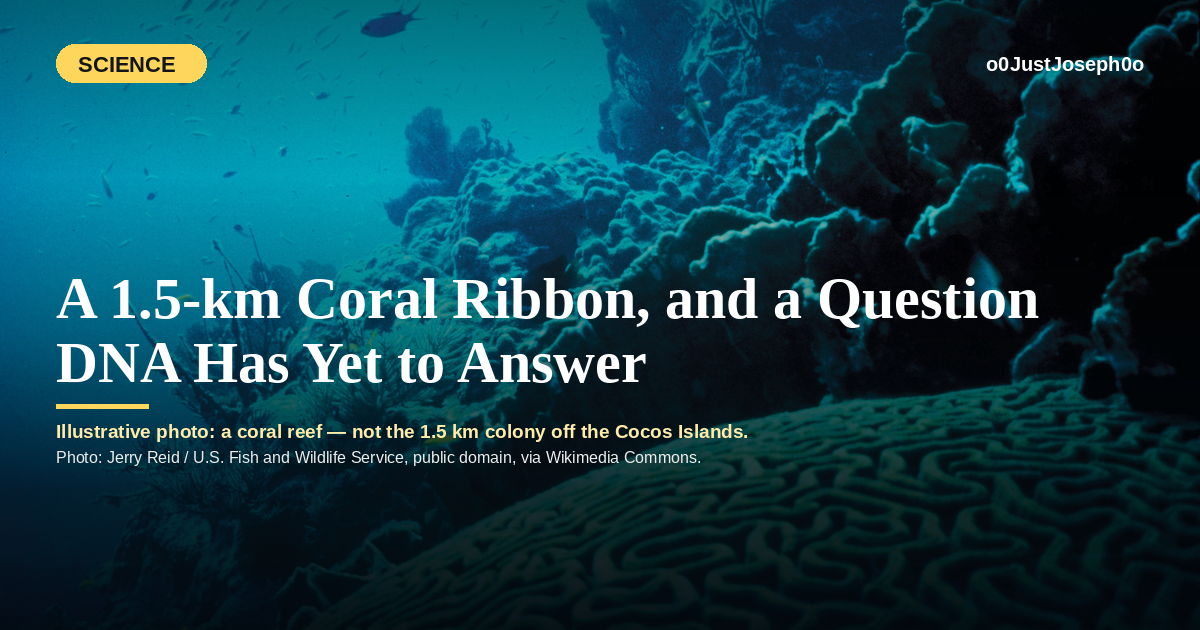
Photo: Jerry Reid / U.S. Fish and Wildlife Service, public domain, via Wikimedia Commons — illustrative image, not the colony described.