
The setup was deliberately ordinary: acrylic boxes with holes of different sizes, and octopuses asked to get from one side to the other. The animals were filmed. The study, from the University of Naples Federico II in Italy, appears in the Journal of Experimental Biology (229(21):jeb252825, DOI 10.1242/jeb.252825).
“These masterful getaways involve a consistent, step-by-step game plan, researchers report November 5 in the Journal of Experimental Biology.” — Science News, 2026-11-05.
The routine begins with probing the opening. The octopus then threads three to five arms through it, and finally squeezes the rest of its body after them. That is the three-step sequence the researchers observed when the hole was wider than the distance between the animal’s eyes.
“When the hole was wider than the distance between their eyes, the octopuses pushed themselves through it in three steps. … When the hole was narrower, common octopuses added a fourth step.” — Science News, 2026-11-05.
The fourth step appeared only at the narrow end of the range. The eye-to-eye span is a proxy for the rigid cartilage around the brain — the part of the octopus that cannot fold. Arms and mantle can pour through a gap; that cartilage sets the hard limit. When the opening was narrower than that span, the common octopuses changed plan.
The study covered three common octopuses (Octopus vulgaris) plus Mayan octopuses. The coverage does not give the Mayan count. The Mayan octopuses often refused the narrow hole altogether, which is a useful correction to any sentence that begins “octopuses squeeze through anything”. A different species, faced with the same gap, may simply decline.
“It’s one of the most characteristic behaviors of octopuses in popular awareness, but the strategies octopuses use have not really been examined systematically.” — Robyn Crook, San Francisco State University, to Science News.
The limits are as important as the finding. This was a laboratory study in acrylic boxes, not wild behaviour, and the numbers are small. What it shows is a repeatable pattern in the animals that did go through — not a universal law for the whole order.
The practical interest is in soft robotics. An animal that can pass a body through a gap smaller than its own hard parts, using a fixed sequence rather than brute force, is a working body plan for a machine that has to do the same.
It does not say every octopus does this. It says that in this lab, with these animals, the ones that went through used a consistent plan — and changed it at a threshold set by the part of them that cannot bend.
Source: Science News, 5 November 2026. Study: Journal of Experimental Biology 229(21):jeb252825, DOI 10.1242/jeb.252825.
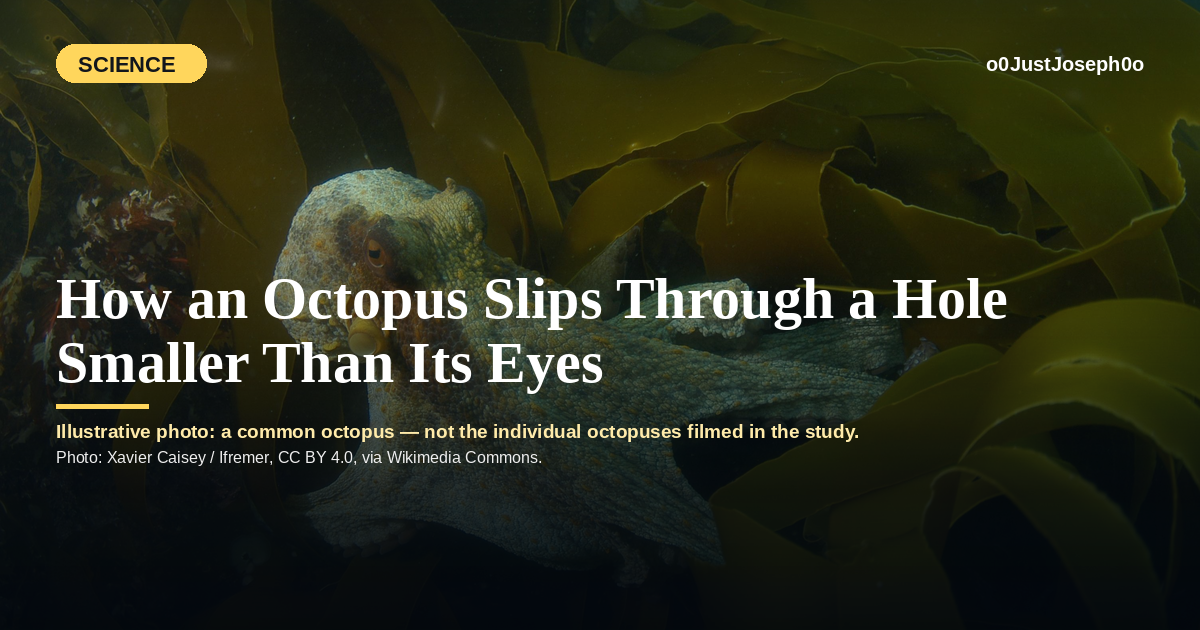
Photo: Xavier Caisey / Ifremer, CC BY 4.0, via Wikimedia Commons — illustrative image, not the individual octopuses filmed in the study.